Understanding flue gas composition is key to optimizing a carbon capture project. Detailed characterization helps systems perform better and adapt to real-world conditions while also limiting unforeseen future costs.
Traditionally, flue gas emissions from industrial facilities have been treated as a waste stream, with flue gas characterization primarily conducted to satisfy environmental regulatory requirements. But when it comes to carbon capture projects, flue gas isn’t just a waste, it’s the primary feedstock for a multi-million to multi-billion-dollar investment.
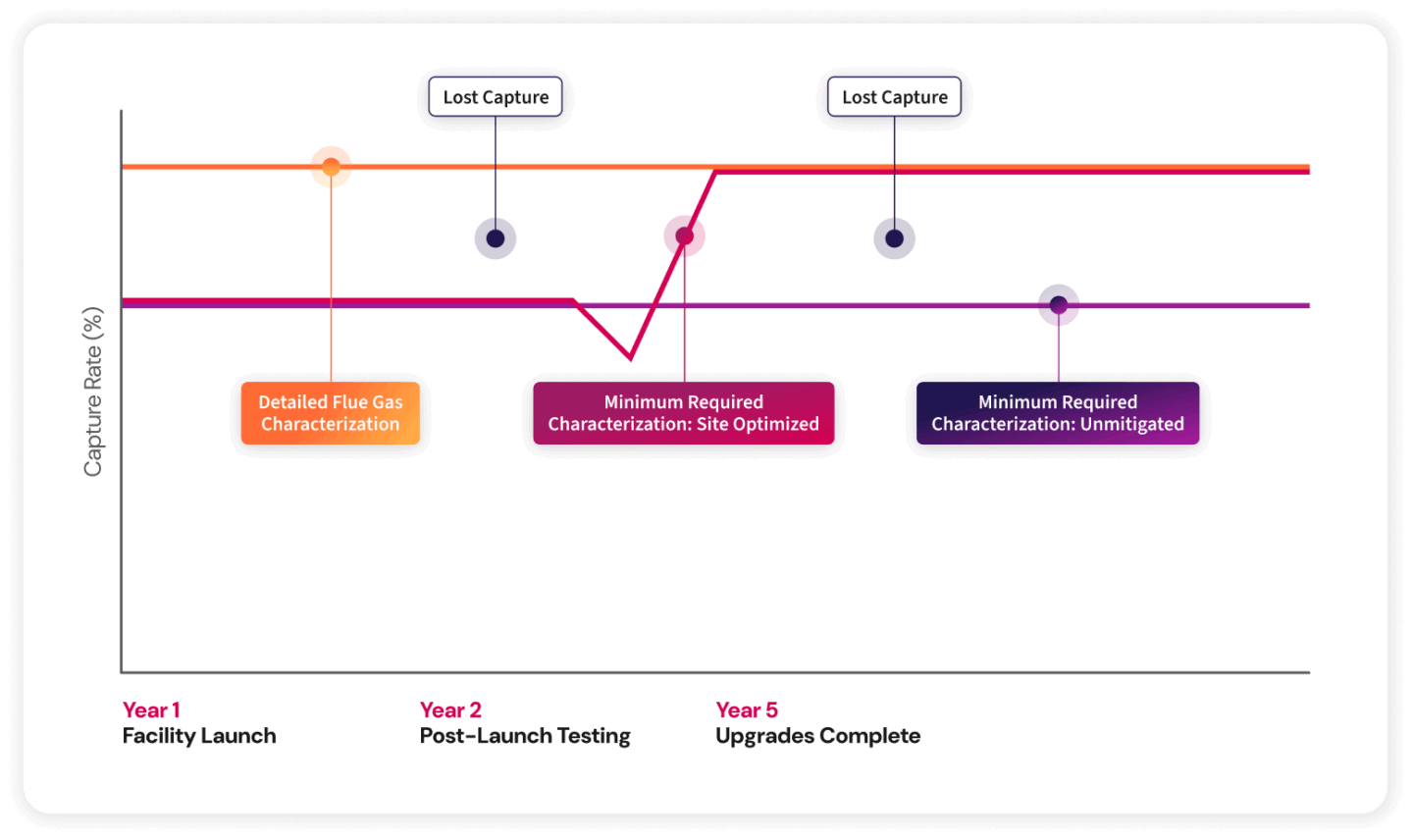
See firsthand how early and thorough flue gas characterization can reduce uncertainty in the design and operation of your carbon capture system. To demonstrate this, we’ve conducted a study comparing three different characterization approaches across several industries:
Detailed Flue Gas Characterization: The plant is designed with adequate pre-treatment, redundancy, amine reclamation equipment and operating costs are minimized.
Minimum Required Characterization with Site Optimization: The initial plant design is inadequate, and capture efficiency is low for the first four years while capital is spent on plant upgrades. Eventually capture efficiency and operating costs match the detailed characterization scenario.
Minimum Required Characterization, Unmitigated: The initial plant design is inadequate, and no additional capital is spent on improvements, capture efficiency remains low and operating costs remain high for the life of the plant.
This study outlines how flue gas characterization can:
- Reduce the levelized cost of capture.
- Increase capture efficiency and rates.
- Optimize system performance and efficiency from the start.
- Reduce site downtime.
Click here to learn more about the study’s methodology and assumptions.
Flue Gas Characterization and Capture Rate
Industry Complexity Categories
Several industries were evaluated in this study. To calculate financial impacts, industries were categorized based on the complexity of their flue gas impurity profiles, which influence both the capital cost assumptions for pre-treatment systems and operating costs for solvent health management when sufficient pre-treatment is not included. Compared to industries with low impurities in the flue gas, industries with high impurity levels face two options. They can invest in extensive pre-treatment systems to deliver a cleaner flue gas to the capture process, or they accept higher operating costs for solvent health management (e.g., increased solvent makeup, filtration, reclamation) and maintenance (e.g., waste handling, frequent equipment cleaning).
Industries were categorized into:
- High Complexity Flue Gas: Assumes high impurity levels. Industries included: cement, iron and steel, pulp and paper, and coal-fired power plants.
- Medium Complexity Flue Gas: Assumes moderate impurity levels. Industries included: refinery, Steam Assisted Gravity Drainage (SAGD).
- Low Complexity Flue Gas: Assumes low impurity levels. Industries included: Natural Gas Combined Cycle (NGCC) power plants.
Levelized Cost of Capture ($/tonne CO2)
- 232
- 433
- 1,323
Interpreting Results
While distinct in their operations, the cement, iron and steel, pulp and paper, and coal-fired power sectors produce flue gases that are equally difficult to treat.
Because the level of complexity in flue gas pre-treatment and solvent management is virtually the same, the impact of detailed characterization is consistent among these four.
While distinct in their operations, the cement, iron and steel, pulp and paper, and coal-fired power sectors produce flue gases that are equally difficult to treat.
Because the level of complexity in flue gas pre-treatment and solvent management is virtually the same, the impact of detailed characterization is consistent among these four.
While distinct in their operations, the cement, iron and steel, pulp and paper, and coal-fired power sectors produce flue gases that are equally difficult to treat.
Because the level of complexity in flue gas pre-treatment and solvent management is virtually the same, the impact of detailed characterization is consistent among these four.
While distinct in their operations, the cement, iron and steel, pulp and paper, and coal-fired power sectors produce flue gases that are equally difficult to treat.
Because the level of complexity in flue gas pre-treatment and solvent management is virtually the same, the impact of detailed characterization is consistent among these four.
Refineries have multiple emission sources throughout their operations. This study focuses on flue gas from the Fluid Catalytic Cracking Unit (FCCU), as it contains a significantly higher concentration of impurities compared to other sources.
Steam Assisted Gravity Drainage (SAGD) facilities often co-fire produced gas with pipeline natural gas to generate steam. Consequently, the resulting flue gas contains a higher impurity load than that of a standard Natural Gas Combined Cycle (NGCC) unit.
NGCC is fueled exclusively by pipeline natural gas, which yields a relatively clean flue gas. Generally, carbon capture licensors can engineer their systems to accommodate specific impurities in this type of flue gas.
Results are shown as zero, reflecting the assumption that no unexpected contaminants are present. Detailed flue gas characterization remains crucial to detect any trace contaminants or unexpected oxygen levels that can shorten solvent life, ensuring licensors are provided with an accurate design basis.

The CCUS Insight Accelerator (CCUSIA) is a partnership between the Government of Alberta and the International CCS Knowledge Centre to accelerate and de-risk CCUS by sharing knowledge and developing insights from projects.