Introduction
A significant challenge in implementing post-combustion amine-based carbon capture technologies on Natural Gas Combined Cycle (NGCC) power plants is the low carbon dioxide (CO2) concentrations (3-5%) in the flue gas, making it difficult to capture the CO2 economically. As carbon capture and storage (CCS) projects are capitally intensive, any opportunities to decrease capital expenditure and operating expenses warrant further evaluation. One option to help reduce costs is Flue Gas Recirculation (FGR), also known as Exhaust Gas Recirculation (EGR), which is a process that’s been researched for over two decades.
What is FGR on NGCC power plants?
In a benchmark facility, the entire flue gas stream from the NGCC power plant is sent to the carbon capture facility. FGR is different as it redirects a portion of the flue gas (up to 40% at full load) back into the combustion air intake of the gas turbine.
Implementing FGR on NGCC power plants results in the following:
- An increased CO2 concentration in the flue gas to the capture facility
- A decrease in the flue gas flow rate to the capture facility
- A decrease in nitrogen oxides (NOX) formation in the flue gas
- A reduction in oxygen (O2) concentration in the flue gas
Operating under low oxygen conditions presents unique combustion challenges that may require modifications or upgrades to the gas turbine (e.g. novel combustor designs) to allow for stable performance. To ensure stable combustion within the gas turbine, minimum oxygen levels of at least 15% in the combustion air dictate the maximum amount of flue gas that can be recirculated. Research and testing on flame stability determined the maximum recommended FGR rate should be 40% or below, as combustion stability and efficiency issues arise at recirculation rates greater than 40%.
Flue Gas Recirculation
-
Flue gas recirculation (FGR) is applicable to natural gas combined cycle (NGCC) power plants integrated with post combustion amine-based carbon capture technology. FGR is also applicable to combined heat and power (CHP) plants utilizing a gas turbine and heat recovery steam generator (HRSG). The main intent of FGR is to raise the CO2 concentration in the flue gas supplied to the capture plant, leading to various operational and economic benefits. Click the tabs below for further details on the process and benefits.
Note: Schematic based on GE Vernova’s exhaust gas recirculation (EGR) system.
-
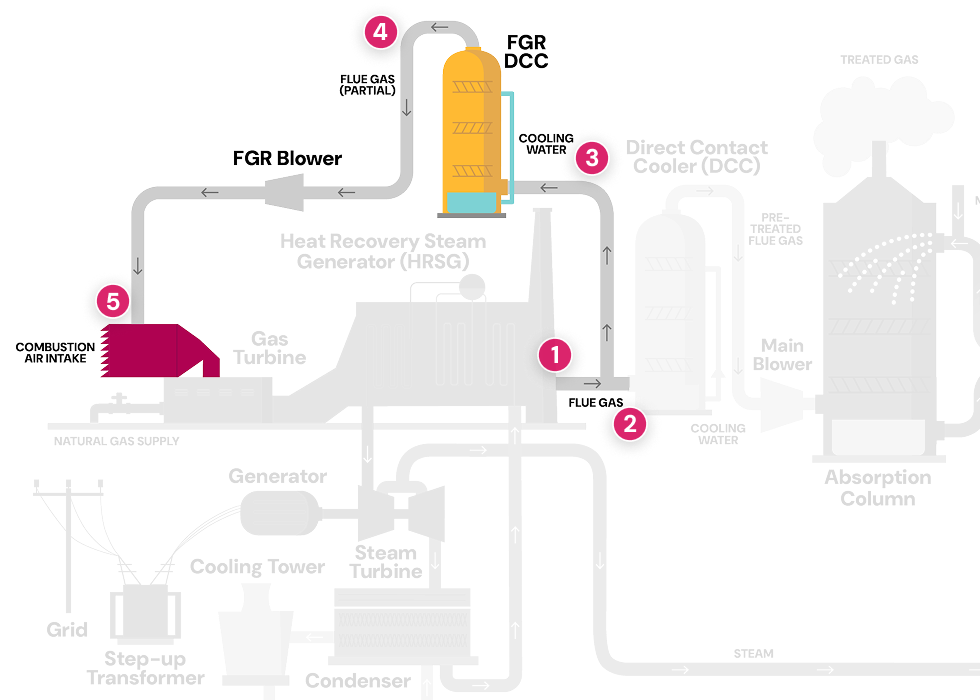
- Typical CO2 concentrations at the stack for commercial gas turbines range from 3 to 5%. With a 40% FGR ratio, flue gas entering the capture plant can range from 5 to 8.3% (Paper No. GT2024-124227).
- The main benefit of flue gas recirculation is increased CO2 concentration and decreased flue gas flow rate to the capture facility. Secondary benefits of FGR include decreased NOx formation and oxygen concentration.
- Recirculated flue gas travels back to the gas turbine via a dedicated flue gas blower and ducting. To ensure stable combustion within the gas turbine, minimum oxygen requirements (min 15%) in the combustion air dictate the maximum amount of flue gas to be recirculated (30-40%). Combustion stability and efficiency issues arise at FGR ratios above 40%.
- A separate DCC is required to cool the recirculated flue gas to temperatures for ideal FGR combustion efficiency. This also serves as a crucial step to remove particulate matter (PM) and water from entering the gas turbine.
- Uniquely designed FGR intake duct is required to efficiency distribute and mix the flue gas with incoming combustion air.
-
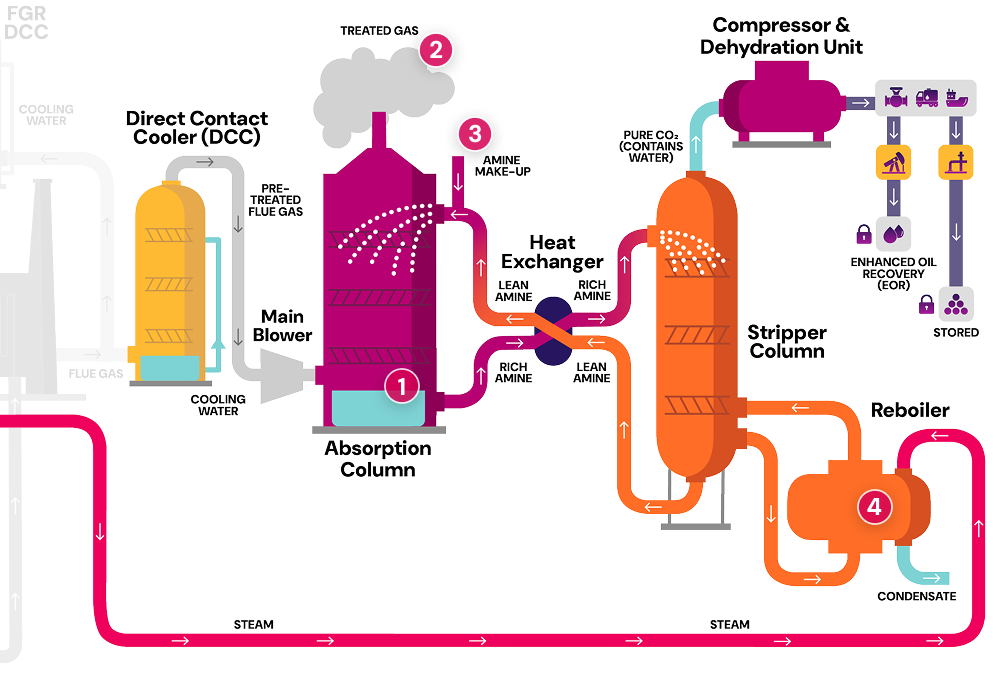
- With higher CO2 concentration in the flue gas, the driving force for CO2 absorption increases, primarily due to the greater partial pressure difference driving CO2 transfer from the gas phase (flue gas) to the liquid phase (amine). This improves mass transfer efficiency, allowing for lower amine recirculation rates and a shorter absorption column. Additionally, a lower overall flue gas volume reduces the size of the largest and most costly equipment in the capture process, including the main blower and DCC.
- Due to the 40% decrease in flue gas volume, NOx, CO and PM is also reduced on a per mass basis, lowering the overall emissions from the integrated plant. For example, if CO concentration remains the same with FGR, due to the 40% reduction in flue gas entering the absorber, less CO emissions on a mass basis exit the stack.
- With lower O2 entering the amine system, amine degradation is expected to drop and thus amine makeup rates reduced, improving overall OPEX.
- As a result of the increase in CO2 concentration in the flue gas, less amine is required to absorb CO2, lowering the specific heat duty of the reboiler. This reduction in amine recirculation rate results in less thermal energy required to “boil off” or separate the CO2 from the amine.
-
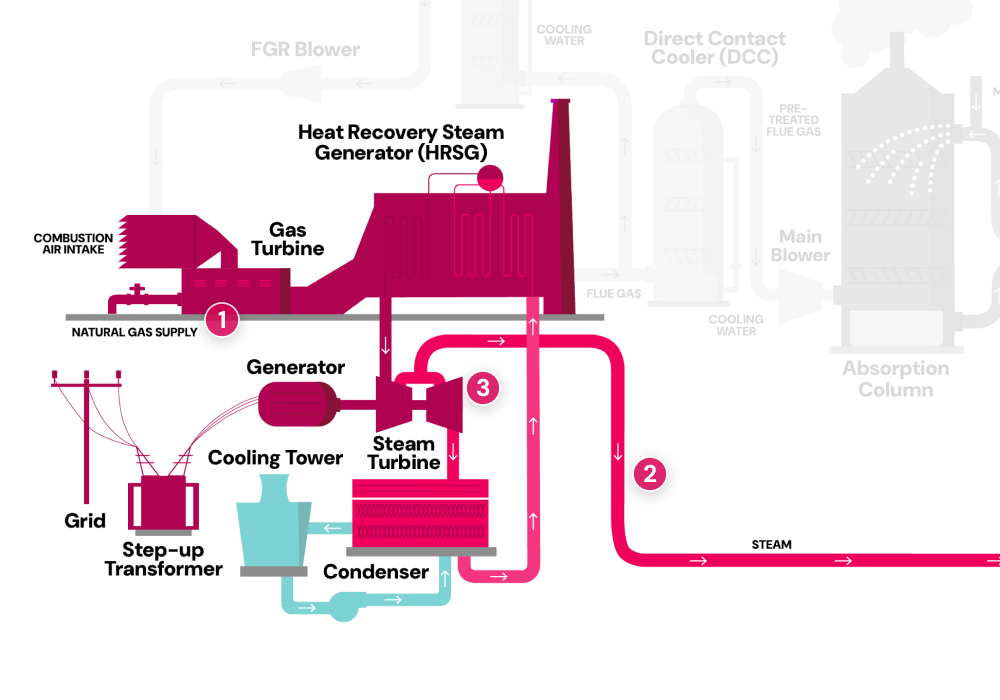
- Modifications or upgrades, not limited to the combustor, are required for a commercial gas turbine to operate with FGR. These modifications allow for stable performance at depleted oxygen levels (i.e. min 15%).
- Due to the decrease in the CO2 reboiler’s specific heat duty, less steam is required for amine regeneration.
- Since less thermal energy is required for amine regeneration, more thermal energy is available for power generation, increasing the net power output of the NGCC.
What are the benefits of FGR on NGCC power plants?
FGR can offer several operational and economic benefits when integrating NGCC power plants with post-combustion amine-based carbon capture technologies. Current studies estimate capital expenditure (CAPEX) savings for the carbon capture plant at greater than 6% (GE Vernova Advances Carbon Capture – Gas Turbine World). It is important to note that these savings do not account for any increased costs associated with additional equipment or potential gas turbine modifications required for FGR. The extent of the total project cost savings may be lower and will be unique to the inherent project (i.e. modification to an existing facility vs. new construction). Based on studies completed to date, FGR also results in savings on operating expenses (OPEX), but exact values have not been quantified and warrant further investigation.
There are several benefits to implementing FGR on NGCC power plants which are outlined below:
Capital savings on equipment
- With a higher CO2 concentration in the flue gas stream entering the capture facility, the driving force for CO2 absorption by the amine increases. This makes capturing the CO2 easier due to the greater partial pressure difference driving CO2 transfer from the gas phase (flue gas) to the liquid phase (amine). This higher reactivity results in a shorter absorption column, which translates into significant equipment cost savings.
- The reduction in overall flue gas flow rate entering the capture facility reduces the size of carbon capture equipment required for the process (smaller direct contact cooler, absorber column and blower) leading to capital savings.
OPEX savings
- Lower specific heat duty – Due to increased CO2 concentration in the flue gas, less amine is required to absorb the CO2 in the absorption column, lowering the specific heat duty of the CO2 reboiler. This reduction in amine recirculation rate results in a reduction of the thermal energy required for the reboiler to heat up and separate the CO2 from the amine in the stripper column, resulting in OPEX savings.
- Reduced amine makeup rates – The reduced oxygen concentration in the flue gas entering the capture facility decreases amine degradation (as amine degradation is accelerated by the amount of oxygen present). This reduction in amine degradation reduces amine makeup rates, decreasing OPEX.
Other benefits
- Decreased emissions from the absorption column – Due to the decrease in flue gas volume entering the capture facility, nitrogen oxides (NOx), carbon monoxide (CO) and particulate matter (PM) are also reduced on a mass basis, lowering the overall emissions from the integrated plant.
- Increased net power output of NGCC power plant – Although studies have shown that FGR generally decreases the power output from the gas turbine, by lowering the steam extraction required for amine regeneration, it can also positively impact electricity generation from the steam turbine. As less thermal energy is required for amine regeneration, more thermal energy is available for power generation, increasing the net power output of the NGCC power plant and making carbon capture more economically viable.
FGR limitations
One limitation of FGR is that it has not been commercially demonstrated on a large-scale capture facility. Physical testing has been conducted, proving FGR is feasible while maintaining stable performance of the gas turbine and combustion system. Over a decade of engineering research and development has gone into this technology, with projects across the globe looking to implement it.

The CCUS Insight Accelerator (CCUSIA) is a partnership between the Government of Alberta and the International CCS Knowledge Centre to accelerate and de-risk CCUS by sharing knowledge and developing insights from projects.