There are two main pathways for carbon capture technologies, pre-combustion and post-combustion capture. These pathways work at different points in the energy and industrial systems, but both play a vital role for meeting climate goals in Canada. Pre-combustion capture removes carbon dioxide (CO2) before the fuel is burned, often as part of hydrogen or gasification processes. Meanwhile, post-combustion capture extracts CO2 from exhaust gases after combustion.
Recognizing the differences between these approaches, and how each aligns with Canada’s evolving industrial landscape, helps ensure policies, projects, and investments are supporting the right solutions in the right places.
Understanding the Capture Pathways
Pre-combustion capture
Pre-combustion carbon capture removes CO2 from fuel before it is burned.
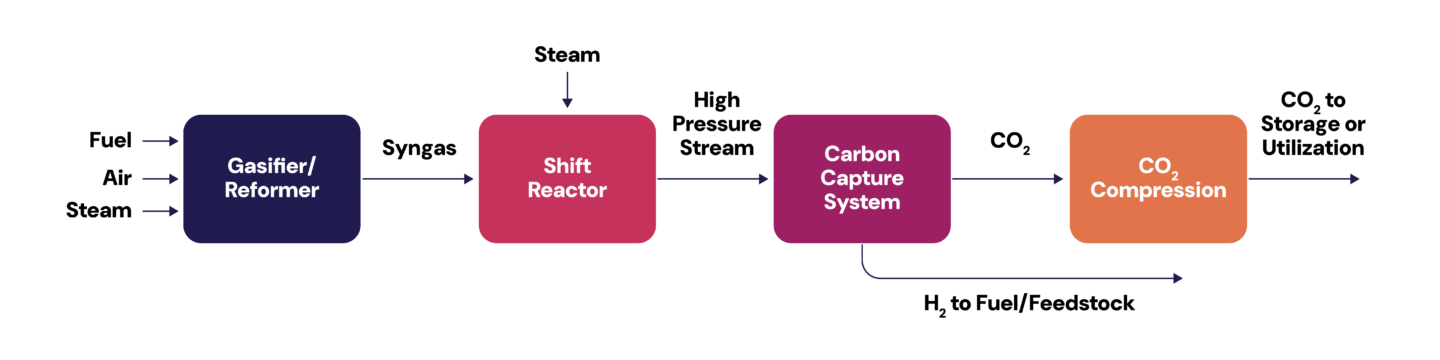
This process converts a hydrocarbon fuel (i.e., coal or natural gas) into synthesis gas (syngas) by reacting it with steam and/or oxygen (O2) in a gasifier or reformer. The syngas, which is a mixture of carbon monoxide (CO), hydrogen (H2), CO2, steam, and other trace components, is then sent to a shift reactor where the CO undergoes a water–gas shift reaction with steam, forming CO2 and additional H2. The resulting high-pressure stream, enriched in CO2 and H2, is sent to the carbon capture system. From there, the CO2 is separated using capture technologies, compressed, and sent for transport, storage or utilization. Meanwhile, the H2 is used as a low-carbon fuel for power generation or as an industrial feedstock. This process is illustrated in the diagram below.
Post-combustion capture
Post-combustion carbon capture occurs after the fuel has been burned in a combustor or furnace.
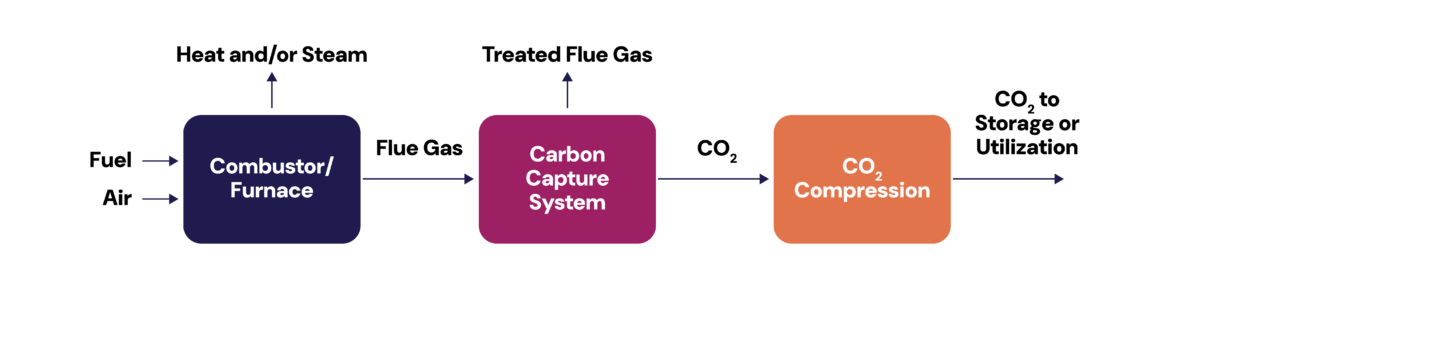
The act of combustion generates heat and/or steam for industrial processes, but it also produces flue gas. This flue gas is primarily composed of nitrogen (N2), water vapour, and CO2 but also includes impurities that are not typically found in pre-combustion processes (such as nitrogen oxides (NOx), sulfur oxides (SOx), particulates and O2). The flue gas is directed to a carbon capture system where it is typically pre-treated to remove these impurities before the CO2 is separated and compressed for transport, storage or utilization. The remaining treated gas is vented to the atmosphere. This process is illustrated in the diagram below.
Oxy-fuel post-combustion capture
Oxy-fuel combustion capture is a type of post-combustion carbon capture that uses pure oxygen (O2) instead of air for combusting fuel, which increases the percentage of CO2 in the flue gas, potentially improving the economics for capture.
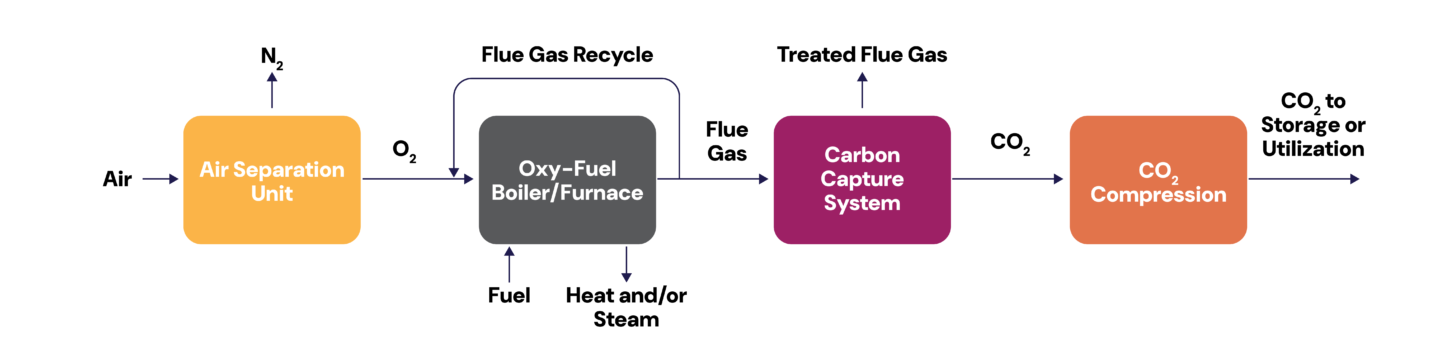
An air separation unit removes nitrogen (N2) from the air, and pure oxygen is sent to the oxy-fuel boiler or furnace for combusting fuel to generate heat and/or steam for industrial processes. The resulting flue gas consists mainly of water vapour and CO2, instead of nitrogen-diluted flue gas which is present in other post-combustion processes. Because burning fuel in pure oxygen creates very high temperatures, some of the flue gas is recycled back to the furnace for temperature control. The unrecycled flue gas is directed to a carbon capture system where the CO2 is separated and compressed for transport, storage or utilization, while the remaining treated gas is vented to the atmosphere. This process is illustrated in the diagram below.
Where Carbon Capture Occurs in Industrial Processes
Most post-combustion capture opportunities consist of directing the flue gas emitted by facilities to a carbon capture system. CO2 can also be captured earlier within industrial processes, primarily through pre-combustion capture. Depending on how a facility produces energy or hydrogen, CO2 can be captured at different points of the process, with some offering multiple potential capture locations. Examples of these capture opportunities include:
- Steam Methane Reforming (SMR): This is the most common industrial process for hydrogen production. Methane reacts with steam to produce syngas, followed by a water-gas shift reaction and separation to yield H2 and a concentrated CO2 stream. Click here to learn more about the SMR process.
- Autothermal Reforming (ATR): Combines partial oxidation and steam reforming in a single reactor, generating heat internally for high efficiency H2 and CO2 co-production. Click here to learn more about the ATR process.
- Gasification: Converts carbon-based feedstocks (such as coal, petcoke, or biomass) into syngas, which is then shifted and separated to yield H2 and a concentrated CO2 stream. Click here to learn more about the gasification process.
- Bioethanol Production: A biochemical process that naturally generates biogenic CO2 during fermentation, offering a negative-emissions opportunity when paired with CO2 capture and storage. Click here to learn more about Bioethanol Production.
Understanding the Strengths, Challenges & Opportunities of Carbon Capture Pathways
Understanding whether CO2 is captured before or after combustion is central for developing effective carbon-management strategies and designing transport infrastructure (such as pipelines) to support the safe and efficient passage of CO2. The location of capture determines the purity and concentration of the CO2 stream, which directly impacts both the cost and technical complexity of a capture project. Simply put, higher CO2 concentrations and fewer impurities make capture easier and less expensive. The strengths, challenges, and opportunities for pre- and post-combustion capture are explored more in the tables below.
Pre-Combustion Capture
| ⚡ Strengths | 🔧 Challenges | 🚀 Opportunities |
|---|---|---|
| CO2 is available at a high pressure and concentration, making separation more efficient and cost effective. | Capture is constrained by the need for existing reforming or gasification units. | Supports production of low-carbon hydrogen and clean-fuel markets. |
| Existing processes produce high-purity CO2 with minimal impurities (such as SOx, NOx, particulates), decreasing pre-treatment requirements and lowering maintenance demands. | Some systems require high-purity oxygen, such as Autothermal Reforming (ATR), increasing energy demand and project cost. | Enables negative-emission BECCS with biogenic feedstocks. For more information on BECCS, check out our BECCS 101. |
| Integrates naturally into hydrogen production systems, such as Steam Methane Reforming (SMR), Autothermal Reforming (ATR) and gasification. | High temperatures and/or pressures add operational complexity. | Supports long-term industrial decarbonization. |
Post-Combustion Capture
| ⚡ Strengths | 🔧 Challenges | 🚀 Opportunities |
|---|---|---|
| Highly suitable for retrofitting existing power and industrial facilities as it connects to existing flue gas systems without requiring major modifications to boilers, furnaces, or turbines. | CO2 is typically captured from low-pressure flue gas with lower CO2 concentrations, making separation more energy-intensive and expensive. | Supports long-term industrial decarbonization. |
| Applicable across many emission sources and across a wide range of sectors. | Flue gas contains impurities such as NOx, SOx, particulates and O2, which require additional pre-treatment and can accelerate solvent degradation, corrosion and waste handling, raising energy use, operational complexity, and overall costs. | Supports modular next-generation systems emerging in Canada. |
| Additional energy required to separate and/or regenerate the capture medium (solvent, sorbent, or membrane system) can impact overall operational complexity and project costs. | Helps decarbonize industrial clusters with shared CO2 networks, while also enabling future BECCS opportunities. |
Why it Matters
Pre- and post-combustion capture are complementary pathways that address different parts of Canada’s industrial needs. Post-combustion capture can be added to facilities in many sectors that emit CO2 when burning fuel, while pre-combustion capture integrates well into hydrogen production, gasification and other clean-fuel processes. Having both options available ensures that CO2 can be captured wherever it is technically feasible, allowing industries to choose the right approach for their operations. Overall, the adoption of either of these applications helps Canada and the world progress towards a low-carbon economy.
From a transport infrastructure perspective, the challenge lies in developing pipeline specifications to accommodate both capture pathways. Pre-combustion systems produce high-purity, high-pressure CO2 streams with few impurities, making them well suited for pipeline transport and storage with minimal conditioning. In North America, CO2 has been safely transported for many years from pre-combustion processes for use in Enhanced Oil Recovery1. There is a growing need to decarbonize from all industrial sectors, which means the increased use of post-combustion capture systems. Post-combustion systems produce CO2 streams with impurities such as SOx, NOx, O2, water vapour and trace metals which are not typically found in pre-combustion processes. These impurities introduce new challenges for the safe and effective transport and storage of CO2, as they can compromise the integrity of the transport and storage system. To meet pipeline and storage specifications, many impurities must be removed or managed, impacting the pre-treatment and dehydration requirements within a capture process.
To help navigate these differences and identify the right solution for each project, it is important to understand how various capture technologies operate across the pre- and post-combustion spectrum. For examples of carbon capture technologies suited for pre-combustion, post-combustion or both, refer to the CCUS Technology Comparison Guide.
Want to see how many operating capture facilities around the world use different capture pathways? Check out Commercial Carbon Capture Plants: International Operating CCS Projects.
Canada’s Carbon Capture Pathways in Practice
Canada provides a real-world demonstration of how both pathways operate in facilities and emerging projects. In Alberta, industrial plants such as Shell’s Quest, North West Redwater’s Sturgeon Refinery and Nutrien’s Redwater CO2 Recovery Unit apply pre-combustion capture within their hydrogen and refining systems based on SMR and gasification processes. Meanwhile, the flexibility of adding post-combustion capture, like amine and modular systems, to existing infrastructure is highlighted through projects like SaskPower’s Boundary Dam Unit 3 in Saskatchewan, and Entropy’s Glacier Gas Plant in Alberta.
Review these case studies for lessons learned on Canadian operational projects:
- Shell Quest Carbon Capture and Storage Facility: A Case Study
- Boundary Dam 3 Carbon Capture & Storage Facility: A Case Study.
Together, these projects illustrate how Canada’s carbon management ecosystem is beginning to span the full capture spectrum, from hydrogen production and bioenergy systems that capture CO2 prior to combustion, to power and industrial retrofits that capture it after combustion. This combination of capture pathways provides a diverse foundation for scaling national CCUS deployment and supporting Canada’s progression towards climate goals. Explore operational, under construction, and planned CCUS projects across Canada here.